Interior Furniture Doodle Illustrations Review
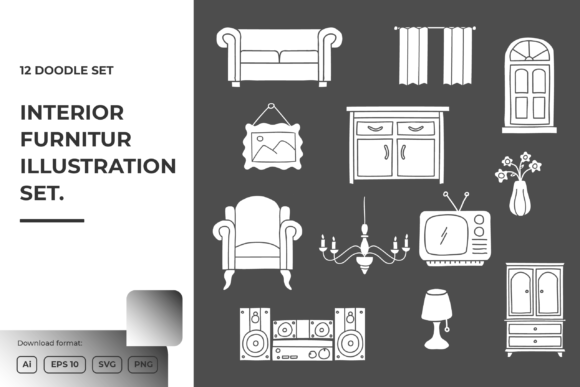
As a designer who spends more time behind an embroidery machine than a computer screen, I approach digital assets with a healthy dose of skepticism. Vector files look pristine on a monitor, but the true test is whether they translate into clean stitches on fabric. When evaluating the Interior Furniture Doodle Illustrations set, my primary focus was not just the aesthetic charm of the hand-drawn style, but the practical viability of these graphics for real-world textile applications. This 12-piece collection offers a whimsical, sketch-like quality that feels distinctly human, which is exactly what today’s market craves. However, moving from a scalable vector graphic to a tangible machine embroidery design requires careful consideration of line weight, detail retention, and fabric compatibility.
Translating Hand-Drawn Charm to Stitch
The immediate appeal of this illustration set lies in its imperfect, organic lines. Unlike rigid architectural drawings, these doodles possess a playful personality that suggests comfort and lived-in warmth. For an Etsy seller or craft business owner, this visual language communicates "handmade" instantly. However, when digitizing these vectors for embroidery, that same organic quality presents specific challenges. A pen stroke on paper has no width limitation; a satin stitch or running stitch does.
In my assessment, these illustrations are best suited for styles that embrace openness. Attempting to convert these intricate doodles into dense fill stitch areas would likely destroy the delicate, airy mood of the original art. Instead, they shine as redwork or outline-style designs. The editable nature of the included AI and EPS files is crucial here. Before sending any file to your machine, you must verify that the line weights can support your chosen thread type. A 40wt rayon thread requires different spacing than a 12wt cotton thread. If the source vectors are too thin, you risk needle breaks or thread shredding; if they are too thick, the design loses its dainty character.
Real-World Application: The Custom Tote Bag Test
To truly judge the utility of Interior Furniture Doodle Illustrations, I mentally prototyped a project for a client requesting a personalized gift for a new homeowner. We settled on a natural canvas tote bag design featuring a cozy armchair and a potted plant from the set. Canvas is a forgiving substrate, but it has texture. The challenge with doodle-style graphics on textured fabrics is clarity. Fine details can get lost in the weave of the canvas.
For this application, I found that increasing the stitch length slightly helped the design sit on top of the fabric rather than sinking in. The hand-drawn aesthetic actually worked in our favor; minor registration shifts or slight puckering that might ruin a geometric logo simply added to the rustic, artisanal feel of the finished tote. This makes the set particularly valuable for makers creating custom apparel or home goods where perfection is less important than character. If you are producing small shop products like tea towels or pillow covers, these illustrations provide a versatile library of motifs that can be mixed and matched without looking repetitive.
Navigating Fabric Limitations and Hoop Sizes
While these graphics are versatile, they are not universally applicable across all substrates. As an experienced reviewer, I must highlight where caution is necessary. Doodle illustrations rely heavily on line definition. On stretchy knits, such as those used for sweatshirt embroidery or baby onesies, maintaining crisp lines is difficult. Even with proper stabilizer, the movement of knit fabric can distort open, sketchy designs.
If you intend to use these for baby embroidery or wearable items, consider using a water-soluble topping to prevent stitches from embedding into the fabric pile. Additionally, pay close attention to hoop size. These furniture illustrations vary in aspect ratio. Some may be tall and narrow (like a floor lamp), while others are wide (like a sofa). Resizing a vector is effortless; resizing an embroidery file after digitization is risky. Always determine your target hoop dimensions before finalizing your digital embroidery file. Scaling down complex doodles often results in overlapping stitches and thread buildup, while scaling up can make running stitches look sparse and disconnected.
Critical Considerations for Dark and Textured Fabrics
- Contrast is Key: These designs rely on line work. On dark fabrics, ensure your thread color provides sufficient contrast. A grey doodle on navy fabric will vanish. Test on scrap material first.
- Avoid Dense Areas: Do not attempt to add heavy backing fills behind these doodles to make them pop. It negates the lightweight, breezy aesthetic of the illustration.
- Curved Surfaces: Be wary of placing linear furniture doodles on curved surfaces like caps. The distortion required to wrap the design around a hat brim can make straight furniture legs look bent or broken.
- Washability: For items like kitchen towels or holiday embroidery that face frequent laundering, ensure your running stitches are secured properly at start and end points to prevent unraveling over time.
Commercial Value and Professional Presentation
For creative entrepreneurs, the value of this asset pack extends beyond the stitch-out. The inclusion of high-resolution PNGs allows for professional printable mockup creation. Before committing to production runs, I strongly advise testing your digitized versions in black and white mockups to evaluate value structure without the distraction of color. This helps identify if the design reads clearly at thumbnail size—a critical factor for online listings.
Furthermore, because these are editable vectors, they serve as excellent design assets for branding consistency. You could use the same furniture doodles on your packaging, thank-you cards, and website headers, creating a cohesive brand identity that bridges digital and physical products. However, a vital reminder for any commercial embroidery venture: always verify the licensing terms included in the ZIP file. Confirm whether you have rights to sell finished physical products, digital files, or both. Protecting your business means respecting intellectual property boundaries.
Designer Notes for Successful Implementation
Before adding Interior Furniture Doodle Illustrations to your permanent library, run through this practical checklist to ensure success in your specific workflow:
- Digitize with Intent: Do not auto-digitize. Manually map out stitch paths to preserve the hand-drawn flow. Auto-digitizers often create jagged, mechanical lines that ruin the doodle aesthetic.
- Test on Target Fabric: Never assume a setting works universally. A setting perfect for quilting cotton may fail on linen or denim. Create a test swatch for every new fabric texture you introduce.
- Evaluate Thread Weight: These illustrations likely perform best with lighter threads. Heavy threads may overwhelm the delicate nature of the furniture sketches.
- Check Small Details: Inspect corners and tight curves. If a detail is smaller than 1mm, simplify it. Embroidery machines cannot replicate microscopic pen details reliably.
- Validate Licensing: Before listing any personalized gift or embroidered patch for sale, read the license agreement thoroughly to avoid future legal complications.
Ultimately, Interior Furniture Doodle Illustrations offer a fantastic foundation for makers seeking to inject warmth and personality into their textile projects. They bridge the gap between modern graphic design and traditional needlework, provided the maker respects the technical limitations of the medium. By treating these vectors as a starting point rather than a final destination, and by prioritizing fabric-appropriate digitizing strategies, you can transform these charming digital sketches into heirloom-quality stitched goods that resonate deeply with customers seeking authentic, handmade connection.