Emergency Situation Vector Illustrations Review
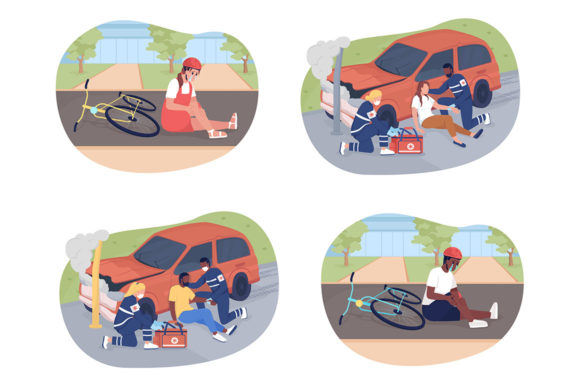
As a professional embroidery designer and product reviewer, I approach every new graphic asset with a specific question: will this actually stitch out well on fabric? When evaluating the Emergency Situation Vector Illustrations collection, my focus shifts immediately from screen to hoop. These graphics depict high-stakes scenes like paramedics assisting at car accidents, bicycle injuries, and childhood falls. While visually striking as digital art, translating these complex, colorful narratives into a machine embroidery design requires careful consideration of density, fabric choice, and end-use application. This review breaks down how these illustrations perform when converted into tangible, stitched products for commercial and personal use.
Visual Impact and Embroidery Translation
My first impression of these Illustrations is that they possess a strong narrative quality rarely found in standard clipart. The scenes are dynamic and emotionally resonant, which is excellent for storytelling but challenging for digitizing. As vector files (AI, EPS), they offer clean lines that are ideal for creating custom embroidery file formats. However, the "colorful scene" aspect mentioned in the product description suggests gradients and shading that cannot be directly stitched. For an Etsy seller or craft business owner, this means you must decide whether to simplify the design into bold color blocks suitable for applique design techniques or invest time in manual digitizing to recreate depth using thread blending.
The mood created by these graphics is one of urgency and care. This makes them uniquely suited for niche markets rather than general apparel. Unlike generic floral or geometric patterns, these designs carry weight. They feel appropriate for safety awareness campaigns, first responder appreciation gifts, or educational materials for children regarding safety. The visual personality is serious yet accessible, avoiding gore while maintaining realism. This balance is crucial for maintaining customer trust and ensuring the finished product is received positively rather than causing distress.
Real-World Application: The Safety Education Tote Bag
To truly test the viability of these Graphics, I mentally prototyped a project relevant to my own client base: a canvas tote bag designed for a community safety fair. The goal was to create a tote bag design featuring a bicycle-related injury scene to promote helmet safety. Canvas is a forgiving fabric with enough structure to support moderate stitch density, making it an ideal candidate for these detailed vectors.
In this scenario, the Emergency Situation Vector Illustrations served as the central focal point. Because tote bags are often viewed from a distance, the bold shapes of the paramedics and bicycle translated well without requiring microscopic detail. I envisioned using a combination of fill stitch for the main bodies and satin stitch for outlining key elements like helmets or medical crosses. This approach maintains the integrity of the original illustration while keeping the stitch count manageable. For a small shop product like this, production speed matters; a design that takes four hours to stitch is not profitable, whereas a stylized version taking 45 minutes is viable. The result is a functional, educational item where the embroidery adds perceived value and professionalism that screen printing simply cannot match on textured canvas.
Navigating Fabric Limitations and Hoop Constraints
While the tote bag scenario worked well, applying these designs to other mediums requires caution. If you are considering baby embroidery or items for thin, stretchy fabrics, proceed carefully. Scenes depicting childhood falls are topically relevant for pediatric safety gear, but baby onesies and lightweight knits cannot support dense stitching. The tension required for complex multi-color scenes can distort delicate fabrics, leading to puckering that ruins the garment. In these cases, I strongly recommend testing on scrap fabric first or opting for a simplified outline version using running stitch to reduce pull.
Similarly, curved surfaces like caps present significant challenges. The panoramic nature of an auto crash or accident scene does not map naturally to the limited, curved area of a hat front. Attempting to force a wide composition into a cap hoop often results in registration errors and lost details at the edges. For headwear, isolate a single element from the illustration set—such as a paramedic’s badge or a safety symbol—rather than the full scene. Always confirm your hoop size capabilities before purchasing or digitizing; these illustrations likely require larger hoops (5x7 or greater) to maintain clarity, which limits their use on smaller items like shirt cuffs or pocket logos.
Commercial Viability and Brand Consistency
For commercial embroidery professionals and digital product sellers, consistency is key. These vector illustrations provide a unified style across multiple scenarios, which is excellent for building a cohesive brand identity. Whether you are selling design assets to other makers or producing custom apparel for emergency services, having a matching set ensures that a sweatshirt featuring a car accident scene looks like it belongs in the same collection as a tea towel featuring bicycle safety tips. This cohesion increases buyer engagement and encourages bundle purchases.
However, visual appeal must be balanced with technical execution. High-detail vectors can look muddy if thread colors are not distinct enough. When converting these to embroidery, avoid subtle color shifts that rely on optical blending; threads do not blend like pixels. Use solid, contrasting colors to define shapes clearly. This is especially important for printable mockups used in online listings. Your digital preview should accurately represent what the needle will produce. Over-promising detail in a mockup that cannot be achieved in stitches leads to returns and negative reviews. Always compare light and dark fabric backgrounds during the design phase, as some colors may disappear against navy or black material common in uniform-style apparel.
Essential Designer Notes for Success
Before adding these Emergency Situation Vector Illustrations to your production lineup or digital store, adhere to these practical guidelines:
- Verify Licensing: Confirm whether the license permits selling finished embroidered goods, digital embroidery files, or both. Vector art licenses differ from embroidery digitizing licenses.
- Test Stitch Outs: Never sell a personalized gift or commercial item based solely on a software simulation. Run a physical test to check for gaps, excessive jumps, or stabilizer issues.
- Stabilizer Selection: Complex scenes require robust backing. Use cut-away stabilizer for knits and tear-away for stable wovens to prevent distortion during the lengthy stitch-out process.
- Simplify for Scale: If resizing down for a patch or sleeve logo, remove interior details. Tiny lettering or facial features will become unreadable blobs below 3 inches.
- Color Mapping: Create a thread chart specifically for these designs. Do not rely on auto-conversion software to pick thread colors for safety equipment; accuracy matters for recognition and professionalism.
- Fabric Texture Check: Avoid placing detailed scenes on terry cloth, fleece, or heavy texture without a topping. The fabric pile will swallow fine lines, obscuring the emergency narrative.
Final Thoughts on Practical Usage
The Emergency Situation Vector Illustrations pack offers immense potential for niche creators, safety educators, and uniform decorators. They bridge the gap between clinical imagery and approachable art, making them valuable for specific embroidery project types. However, they are not "plug-and-play" designs for beginners. Success depends entirely on your willingness to adapt the vector art to the physical realities of thread and fabric. By respecting stitch density limits, choosing appropriate substrates like canvas or twill over delicate knits, and prioritizing clarity over complexity, you can transform these digital scenes into high-value, professional embroidered goods that resonate with your audience and stand up to real-world wear.